

Guest blog from Woughton Community Council, Council Manager, Steve McNay.
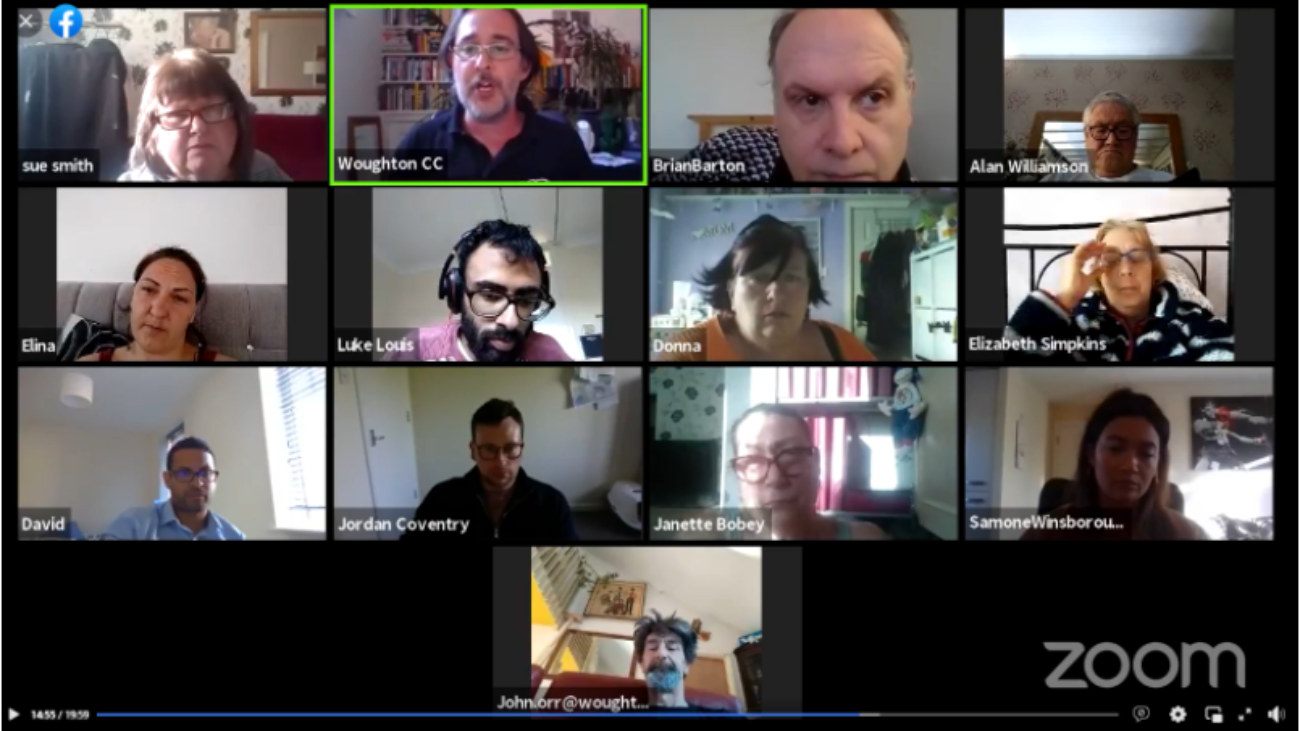
Feature image credit: Woughton Community Council’s Policy & Resources Committee, 20th April 2020 (online)
The recent pandemic has meant that local councils (town, parish and community councils) have needed to adjust, adapt and innovate to ensure services, support and the legal functions of the council were able to continue.
From installing safety screens and hand sanitisers, to developing new travel plans to prevent vehicle sharing – service provision changed almost on a weekly basis as 2020 progressed.
The ‘stay at home’ order and the need to maintain distancing meant alternative approaches to meetings needed to be considered to.
For local councils, where legislation meant that ‘in person’ meetings had been the only option for well over a century, this was both a challenge and an opportunity.
Woughton Community Council (WCC) had, towards the end of 2019, invested quite heavily in new technology, moving the entire officer base onto new, Office 365 enabled laptops and issuing all councillors with tablets. This was a decision that was most fortuitous, as it meant that ‘online’ was simple – everyone had the equipment, the software and, for most, the expertise to be able to use it effectively.
On 4th April 2020, legislation* was introduced that allowed remote meetings to take place. WCC was one of the earliest councils to take advantage of this, holding our first remote meeting less than two weeks later – a meeting of our Policy and Resources Committee. Using Zoom, we had councillors and officers in attendance, plus David Hall from CloudyIT, ensuring that technology didn’t let us down. (It didn’t – all worked perfectly.)
Tech options
There was considerable discussion about the correct technology to use, with councils across the country taking very different approaches.
MS Teams was, at that time, limited in terms of visible participants and streaming needed additional software and expertise.
GoToMeetings was an established player but felt clunky and hard to use as well as participants needing additional software downloading.
Zoom had issues regarding security, with people joining meetings without invite and potential for data breaches.
So none were perfect, but Zoom was easy to use, accessible and given the need for meetings to be public, the security issues were less important for us. It also meant that the legislative demands (that participants should be heard and, where possible, seen) were complied with.
A shift in public engagement
This meeting was also livestreamed to Facebook, using the simple ‘streaming’ tools within the software – in terms of transparency and inclusive democracy, this was the most ‘public’ meeting we had ever held, which was reflected in the viewing numbers – 289 views of this video to date. Considering public attendance at council meetings over the previous two years had been 27 in total, this felt like a significant shift in engagement from our residents.
During the remainder of 2020 and into early 2021, we continued to meet this way. In total, we held 49 entirely online meetings, including the Annual Meeting of the Parish. All were broadcast live and remain accessible to all. And over this time, we had engagement at levels that remained similar to that initial meeting – hundreds of views for each meeting, with comments and feedback that was revelatory – we got knowledge and understanding that had not happened with ‘in person’ meetings and an immediacy that reflected the interactive nature of social media.
Remote meetings for continued democracy
In May 2021, the legislation allowing remote meetings ended. For many councils, remote meetings had replaced in-person meetings completely – the safety issues were simply too great to meet in person whilst a pandemic continued to flow through the population. With the average age of a parish councillor in England being 60, many were vulnerable and unwilling to place themselves at risk. Risk management processes within councils meant that officers were unable to attend at all, as this would be in breach of health and safety legislation. Other attendees had caring responsibilities or other demands and there was a real challenge to ensure democracy could continue.
The need for hybrid meeting solutions
We saw councils paying thousands of pounds for rental of large conference centres to enable suitable spacing, holding one meeting to delegate all powers to the (unelected) Clerk and then retreating or simply deciding to ignore the legislation and carry on with online meetings.
The inaction at governmental level to enable local councils to continue to use technology, as many had very successfully over the past year, meant that local democracy suffered, and fewer councils and councillors were able to fully represent their communities. This was not the case in Wales or Scotland, where remote meetings are not only legal, but encouraged.
At Woughton, we saw an opportunity to build upon the positive impacts already made – how could we continue to broadcast meetings utilizing a ‘hybrid’ approach? If we had to be ‘in person’, but wanted to enable involvement remotely AND broadcast to maintain the positive engagement and involvement of the local community, how could we manage that?
Supported by CloudyIT
Working with our partners at CloudyIT, we investigated options, prices, and viability. Some councils had taken a ‘get a webcam and a microphone’ approach, with others installing multiple cameras, individual microphones and having a technician managing the meetings. WCC took a path between these two options, investing in a Rally Bar Mini, with AI technology and multiple microphones that ensured a decent sound quality for viewers.
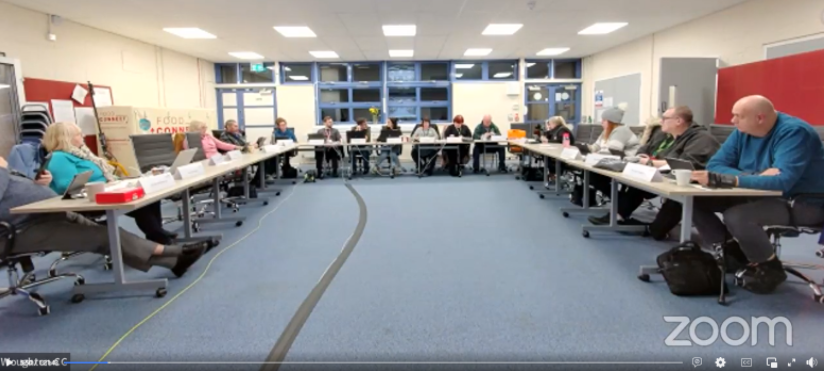
Our Council Meeting Setup
This approach means that the room can be set up, the camera and microphones started and then simply treat the meeting as normal – once the ‘stream to XXX’ button is pushed, the system allows participants to simply continue as usual with no need for anything further. The screen that is used to share pertinent slides can still be used, allowing viewers to see the same information and, to all intents and purposes, those watching online have the same involvement as if in the room.
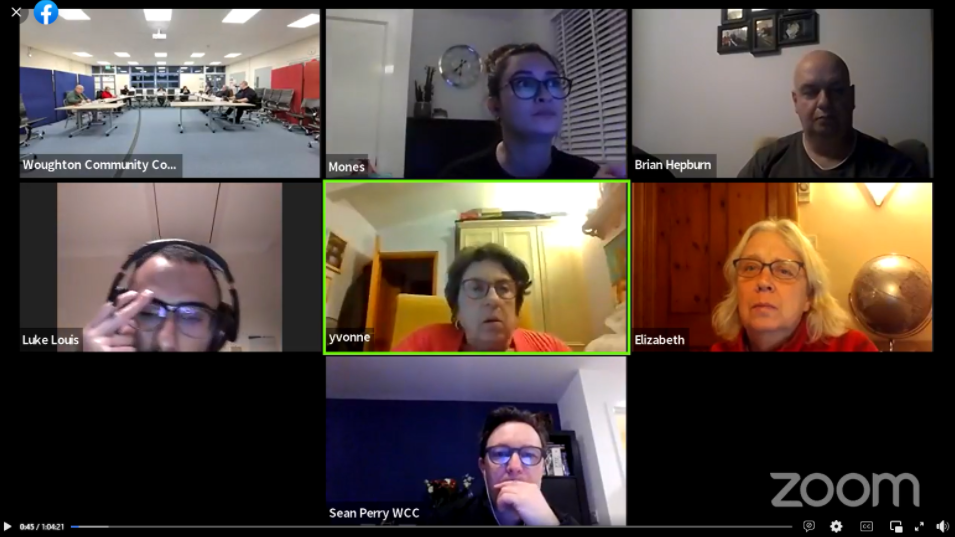
This can further be used for ‘hybrid’ approaches, which has been the most recent approach from many councils – having a ‘quorate’ number of councillors in person, with other attending remotely, having the discussions and then decisions ratified by those legally ‘present’ – whilst this may be seen as a long-winded way of making decisions, it is legally compliant and ensures that safety and wellbeing don’t become barriers to democracy.
Unprecedented benefits
Broadcasting has been a hugely valuable way of building engagement with our communities. Our meetings over the first year of broadcasting saw 10’s of thousands of views, thousands of reactions and comments and offered us insights that we have previously lacked through ‘in person only’ approaches. Not only our Full Council and committees, but resident association forums, police consultation events, 2020 Remembrance Services, weekly parish updates – broadcasting and making use of social media to enable this has brought many to the council that would previously have been unknown.
When asked, people have said that being able to watch a meeting means that they can carry on with ‘life’, whilst still keeping up to date – people watch on a tablet whilst cooking, or on their phones on the bus. For many, having the ‘watch again’ feature has meant that whilst they would be unable to attend at a fixed time, they can tune in whenever they get a chance, simply by clicking a button.
A virtual future
WCC chose Facebook as our broadcasting medium, but YouTube, Vimeo and a range of other providers are also options. Facebook was felt most suitable as this was an already established method of communication with our residents, with most people being able to access it easily. It also ensured we had the expertise and tools needed to be able to monitor, react and address concerns raised, including responding in ‘real time’ to comments, where appropriate. We have also been able to put our meetings into playlists – a ‘Planning Committee’ playlist is, undoubtedly, a fine solution to insomnia!
The future will, I suspect, be more virtual. Hybrid meetings are now the norm in many industries and, whilst local government is rarely the quickest to evolve, the recent experiences have shown the value, the benefits and the impact that broadcasting can have on transparency, engagement and democracy at the very local level, closest to those that we serve.
FOOTNOTES
*Local authorities were permitted to hold virtual meetings from 4 April 2020, when regulations came into force. These are the Local Authorities and Police and Crime Panels (Coronavirus) (Flexibility of Local Authority and Police and Crime Panel Meetings) (England and Wales) Regulations 2020 (SI 2020/392), made under section 78 of the Coronavirus Act 2020.
These regulations applied to all local authorities in England and Wales, including parish, town, and community councils. They specify that a ‘meeting’ of a local authority can lawfully take place online, with members ‘in remote attendance’ who can hear and be heard by, and if possible, see and be seen by, other members.


