Thank you to Linda Chandler, Industry Executive for Local Regional Government at Microsoft, for contributing this article. Here, Linda elaborates on key points she joined us in discussing at the SLCC Practitioner's Conference in February 2022 for our presentation marking the launch of our Digital Levelling Up programme. (SLCC members can watch the session free of charge by requesting the recording here.) Read the full article for an insightful view of how the future of work has the potential to help our high streets, and how stakeholder collaboration at a hyperlocal level is crucial for achieving place-based agility.
Three clear shifts are aligning to make digital innovation relevant for places of all sizes: the affordability of smart city technology, the future of work and the cohesion of our communities.
From Smart Cities to Smart Places
When we think about the different pillars of a city – government, transport, education, health, retail etc. these are equally present on a smaller scale and are as recognisable in our district and parish councils as they are at a city or county level.
Computing power in the 1980s was only available to a smaller number of organisations that could afford mainframe computers, but the 1990s saw the democratisation of this through ‘personal computers’ (PC) which combined with the global connectivity of the 2000s and the mobility era of 2010, have democratised technology for the average person in the street.
Source: Evolution of Technology and User Interactions, Kuldeep Singh, Medium -https://medium.com/xrpractices/evolution-of-technology-and-user-interactions
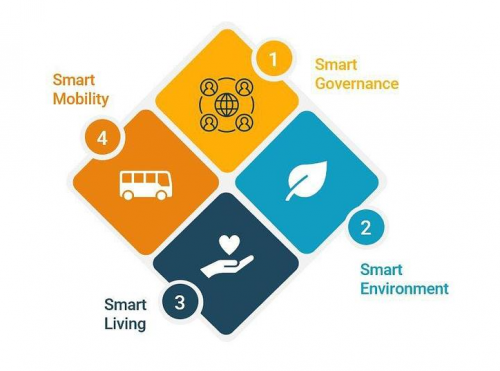
More than a decade ago the phrase ‘smart cities’ made its entrance into the lexicon of how we talk about digital and place. At the time this was probably more “technology-push” than “citizen-pull” but as technology has become more reliable, faster and cheaper over the years and as societal acceptance and adoption of technology has grown, we are at an interesting point where technology that was only the preserve of the major global cities – say of London, Singapore or Barcelona – is now within reach of our towns and communities.
Source: Smart places: from smart cities to smart towns and communities - https://www.farrpoint.com/smart-places
The Future of Work and the High Street
Another trend which has been growing for over a decade is that of flexible working. Microsoft technology has been at the forefront of enabling the future of work and as an organisation we have been involved in shaping it for some time. From being active in a government-backed initiative called the ‘Anywhere Working Consortium’ that was launched in 2011 to our more recent Work Trend Index and New Future of Work research.
Fast forward a decade and for those that could, the pandemic really forced some of us into the world’s largest working from home experiment. However, working from home and working in the office are extremes on a spectrum of places to work, but real life is rarely so binary.
While many find working from home flexible and productive, some find it isolating and do not have the facilities at home to accommodate a working environment.
Hybrid working: 6 Dec 2021 Woughton Community Council broadcasted council meeting
I’m sure you could walk down a high street near you and find many workers with their laptops perched on tables in coffee shops, escaping the confines of home.
What if your high street had a co-working space which was more conducive to supporting a work environment near to home?
What would that do for both the daytime economy and for supporting community connections?
Cohesive Communities and the Eco-system of Place
Digital technology is no longer confined to organisations, but is present in almost every aspects of our lives, places and society.
We also recognise that the power of place is not just about local government.
It’s about the community of local organisations – an ‘eco-system of place’ – public services such as health, care, education etc., local businesses, social enterprises, the voluntary sector, residents.
Hyperlocal networks came into their own during the pandemic – they proved that they were close to understanding local issues, could act with agility and be innovative around how they create impact.
It’s my hope that the democratisation of smart technology, coupled with taking control over the future of local working can create the engagement, stakeholder connections and place-based agility that our towns and communities need.
Let’s face it – we all stand to gain from this approach – it’s not so much about smart technology, but developing smart sustainable economic futures in the places we live.
We use essential cookies necessary for the operation of our website. We'd like to set some additional cookies to understand how you use our website, remember your preferences, and improve your experience.
Please use the link below to manage your Cookie Settings or click the "Accept" button to consent to the use of ALL cookies.
To help you decide, you can read more about the cookies we use at our Cookie Policy.
This website uses cookies to improve your experience while you navigate through the website. Out of these, the cookies that are categorized as necessary are stored on your browser as they are essential for the working of basic functionalities of the website. We also use third-party cookies that help us analyze and understand how you use this website. These cookies will be stored in your browser only with your consent. You also have the option to opt-out of these cookies. But opting out of some of these cookies may affect your browsing experience.
Necessary cookies are absolutely essential for the website to function properly. These cookies ensure basic functionalities and security features of the website, anonymously.
Cookie
Duration
Description
cookielawinfo-checbox-analytics
11 months
This cookie is set by GDPR Cookie Consent plugin. The cookie is used to store the user consent for the cookies in the category "Analytics".
cookielawinfo-checbox-functional
11 months
The cookie is set by GDPR cookie consent to record the user consent for the cookies in the category "Functional".
cookielawinfo-checbox-others
11 months
This cookie is set by GDPR Cookie Consent plugin. The cookie is used to store the user consent for the cookies in the category "Other.
cookielawinfo-checkbox-necessary
11 months
This cookie is set by GDPR Cookie Consent plugin. The cookies is used to store the user consent for the cookies in the category "Necessary".
cookielawinfo-checkbox-performance
11 months
This cookie is set by GDPR Cookie Consent plugin. The cookie is used to store the user consent for the cookies in the category "Performance".
viewed_cookie_policy
11 months
The cookie is set by the GDPR Cookie Consent plugin and is used to store whether or not user has consented to the use of cookies. It does not store any personal data.
Functional cookies help to perform certain functionalities like sharing the content of the website on social media platforms, collect feedbacks, and other third-party features.
Performance cookies are used to understand and analyze the key performance indexes of the website which helps in delivering a better user experience for the visitors.
Analytical cookies are used to understand how visitors interact with the website. These cookies help provide information on metrics the number of visitors, bounce rate, traffic source, etc.
Advertisement cookies are used to provide visitors with relevant ads and marketing campaigns. These cookies track visitors across websites and collect information to provide customized ads.
Other uncategorized cookies are those that are being analyzed and have not been classified into a category as yet.
Stay up-to-date with the latest CloudyIT news & events
We are digital transformation experts, helping councils, law firms, charities and SMEs to transform their IT and embrace modern, more efficient systems and working practices.








Add a Comment